

Do you know the iconic motto of House Stark from the Game of Thrones TV series: „Winter is coming!”? Me too! I mean, it’s hard to miss it… the meme was all over the internet for so long. Okay, now that I’ve got your attention, you’re probably wondering what this motto has to do with SEO and AEO, right? Well, SEO specialists like me also had the same feeling that tough times were ahead when we first heard about the growing popularity of AEO in our industry.
Then, a series of crazy but justified questions popped into our minds: „Is SEO already dead?”, „Will people no longer find our client’s website through search results?”, „Will ChatGPT be the only digital asset that helps us sell?” And the list goes on. Believe me when I tell you this: SEO & AEO make the most powerful team ever. Let’s find out together how this is even possible!
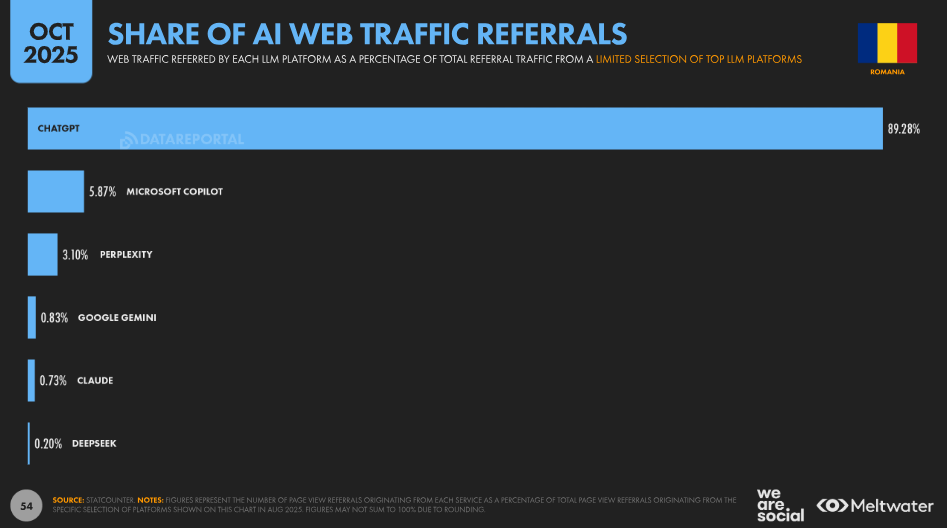 Source: DataReport, Romania, 2026
Why are these statistics relevant to us? It matters because the growing use of AI shows us that people are spending more and more time in other places than those where we focus our marketing efforts to gain visibility. We’re not talking about a trend that will fade away in a few months, but rather about new platforms that are setting the tone for a new way of spending time online and shaping new consumer behaviors.
There’s no doubt that artificial intelligence is here to stay. And here, in the spotlight, is this AEO that everyone is talking about. AEO means Answer Engine Optimization and it sounds like a promise that makes your life easier, isn’t it? Keep this in mind, and let’s deep dive into the question: „SEO & AEO: Who will dominate?”.
 We’re all familiar with search engines like Google, Bing, DuckDuckGo, and so on. These traditional search engines display a list of links that users can browse, a list of search results where we want to rank as high as possible. That is the goal of a SEO strategy.
In contrast, AI search engines (like ChatGPT, Perplexity, Gemini, and so on) provide direct, conversational answers tailored to the user’s intent. This is the reason why AEO is becoming increasingly appealing: in a world where we no longer have the patience to search through dozens of sources for an answer to our question, we choose the quickest route that gives us the answer on a silver platter.

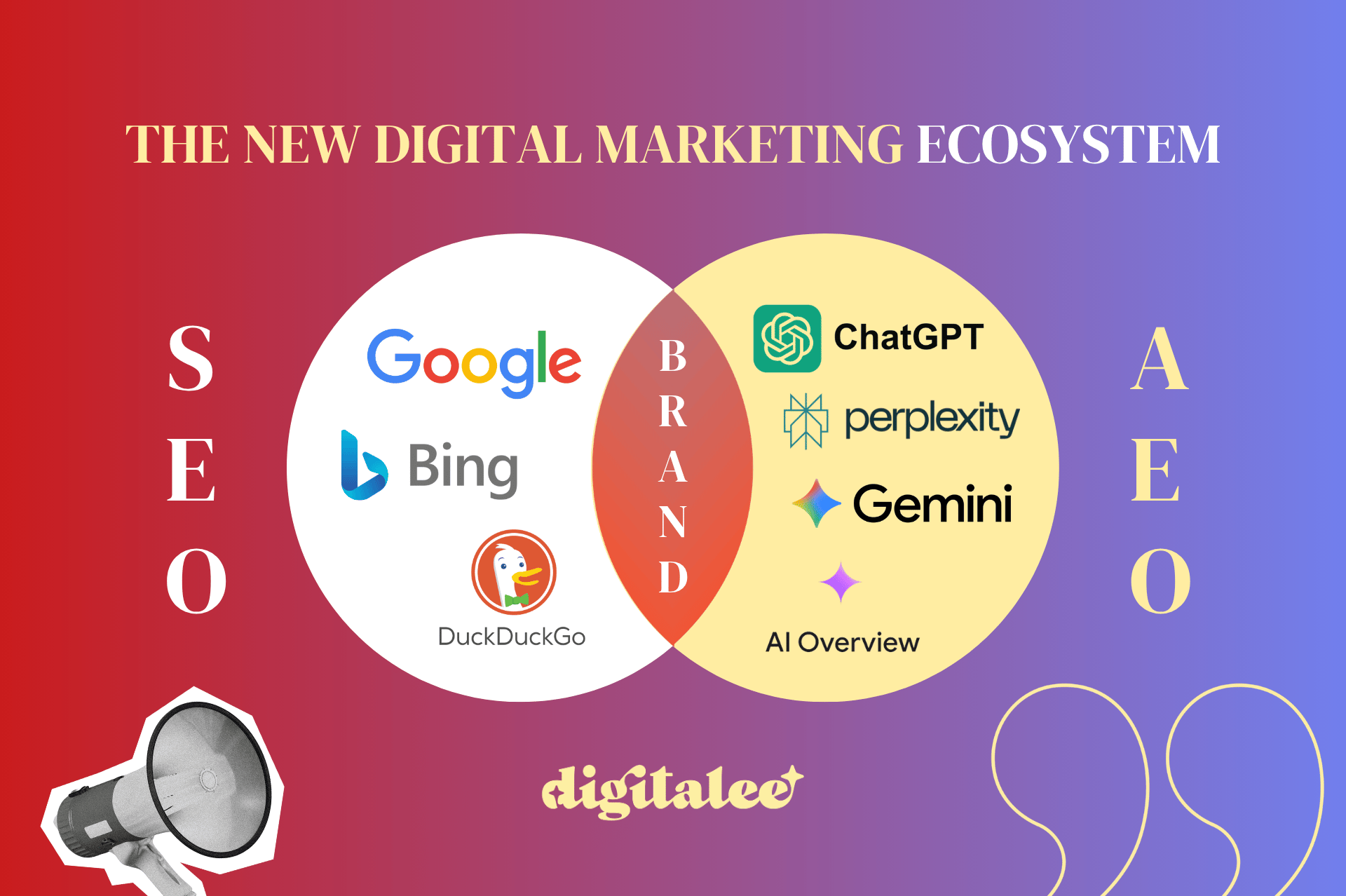 AEO has led to the emergence of a new Digital Marketing Ecosystem in which SEO and AEO make the best team for your brand. One of the most significant benefits that AEO brings to a SEO strategy is the increased visibility. A brand will no longer depend solely on the visibility of its website pages or social media posts in search engines, but will also appear in the responses generated by AI agents.
Increasing the conversion rate is the most attractive benefit, especially for ecommerce platforms. People who visit the brand’s website via an AI search engine have a clearer intention and a genuine need to purchase a product, making them more likely to place an order.
A third benefit that also has a significant impact on users’ decisions is the increase in brand trust and authority. Users feel that they will save time and energy by interacting with an AI agent, because they can ask specific and complex questions to get a direct answer to their problem, without having to scroll through a long list of options (from the search results).
In this new era, there are more important things to think about, like:
A New Era is coming… or is it already here?
Artificial Intelligence has become the new normal in our daily lives. Over the past year, ChatGPT has emerged as the most widely used LLM in Romania (it won the race among AI agents with 89,28%), according to the country report published by Data Reportal. We also discovered a new AI tool called Perplexity where, apparently, one of our clients has a very good score! If you’re already using it, we’d love to hear how it helps you in your professional work.
Source: DataReport, Romania, 2026
Why are these statistics relevant to us? It matters because the growing use of AI shows us that people are spending more and more time in other places than those where we focus our marketing efforts to gain visibility. We’re not talking about a trend that will fade away in a few months, but rather about new platforms that are setting the tone for a new way of spending time online and shaping new consumer behaviors.
There’s no doubt that artificial intelligence is here to stay. And here, in the spotlight, is this AEO that everyone is talking about. AEO means Answer Engine Optimization and it sounds like a promise that makes your life easier, isn’t it? Keep this in mind, and let’s deep dive into the question: „SEO & AEO: Who will dominate?”.
From rankings to recommendations in the SEO & AEO Era
We’re all familiar with search engines like Google, Bing, DuckDuckGo, and so on. These traditional search engines display a list of links that users can browse, a list of search results where we want to rank as high as possible. That is the goal of a SEO strategy.
In contrast, AI search engines (like ChatGPT, Perplexity, Gemini, and so on) provide direct, conversational answers tailored to the user’s intent. This is the reason why AEO is becoming increasingly appealing: in a world where we no longer have the patience to search through dozens of sources for an answer to our question, we choose the quickest route that gives us the answer on a silver platter.
The „zero-click” era
While a SEO strategy aims to drive as many clicks as possible to the brand’s website from organic search results, AEO is a game-changer that introduces us into the „zero-click” era. An era in which users will no longer scroll down to the tenth result on search engines, or perhaps even the first five pages… Instead, they will be more satisfied with the answer provided by AI Overview, which already appears on the first page of Google search results, without having to click on any additional links. Brands will no longer wait for users to click on their links either; instead, they will focus their efforts on positioning their content to appear directly in the AI’s responses. Every brand will want to be the AI agents’ top choice when they make recommendations to their customers.
How can we do that?
There are a few essential tactics in a SEO strategy:- Optimizing website pages based on focus keywords;
- Technical optimizations for efficient website performance;
- Improving the website structure based on UI/UX principles;
- Building backlinks to signal authority and trust.
- We won’t just include keywords in the content page, but also conversational phrases. Imagine what a Topical Map made up of your customers’ questions would look like!
- Technical optimizations will also be designed to help AI agents navigate the site.
- We will create more Q&A sections on the website pages to help AI agents find answers to customer questions more easily.
- We will begin to include more quotes, expert opinions, and verified data to improve our chances of appearing in AI search engines.
The New Digital Marketing Ecosystem
AEO has led to the emergence of a new Digital Marketing Ecosystem in which SEO and AEO make the best team for your brand. One of the most significant benefits that AEO brings to a SEO strategy is the increased visibility. A brand will no longer depend solely on the visibility of its website pages or social media posts in search engines, but will also appear in the responses generated by AI agents.
Increasing the conversion rate is the most attractive benefit, especially for ecommerce platforms. People who visit the brand’s website via an AI search engine have a clearer intention and a genuine need to purchase a product, making them more likely to place an order.
A third benefit that also has a significant impact on users’ decisions is the increase in brand trust and authority. Users feel that they will save time and energy by interacting with an AI agent, because they can ask specific and complex questions to get a direct answer to their problem, without having to scroll through a long list of options (from the search results).
In this new era, there are more important things to think about, like:
- How often is my brand mentioned by AI response engines when users search for my products and/or services?
- How often is my brand recognized by AI response engines compared to my competitors and recommended over them?
- What tone do AI engines use when generating brand-related responses (do they use positive, negative, or neutral language)?
- How visible is my brand in the responses generated by AI engines, compared to competitors, to questions such as: “the best product category” or “compare brand X with competitors”?

Post A Comment